Introduction
This article revises the locally retained translation of BioLogic’s all-solid-state battery overview.
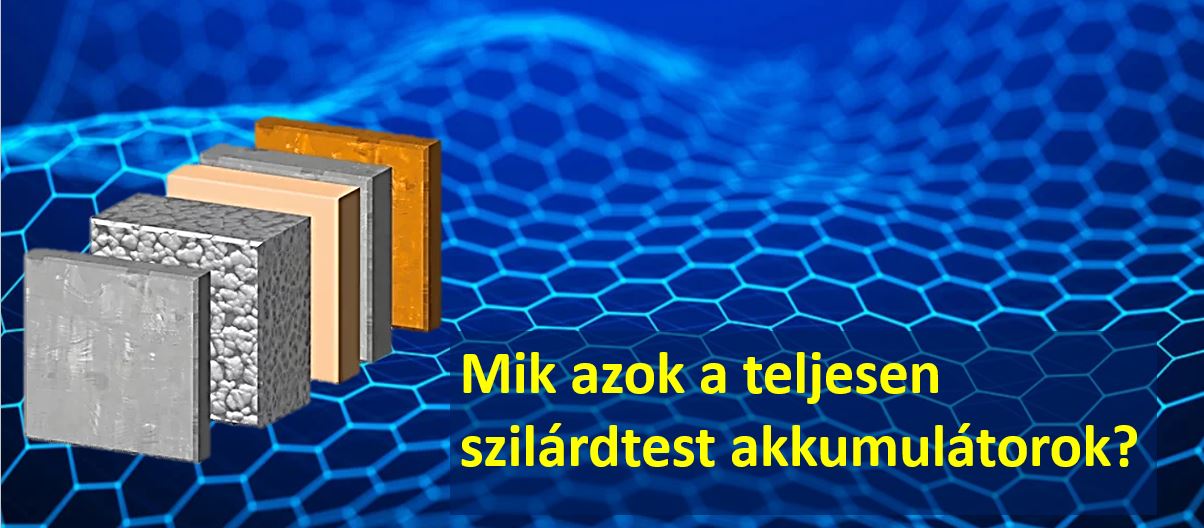
All-solid-state batteries (ASSBs) aim to address limitations of conventional lithium-ion batteries by replacing liquid electrolyte with solid materials. Goals include improved safety, energy density and lifetime for applications from portable electronics to electric vehicles and energy storage. These are development objectives rather than automatic benefits of every solid-state cell.
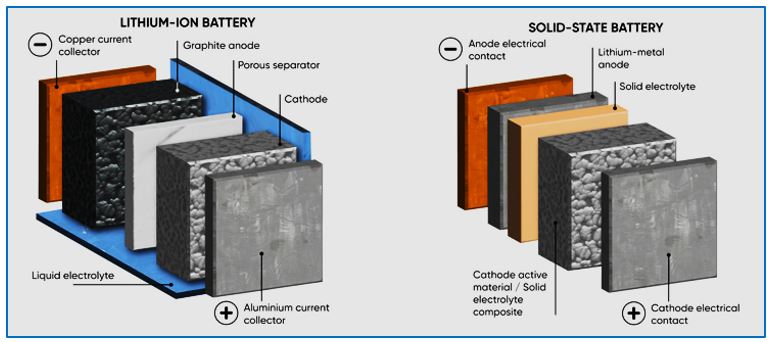
Conventional cells use liquid or gel electrolytes; ASSBs use solid electrolytes. Candidates include ceramics, polymers and glass or composite materials. Solid electrolytes can reduce risks associated with leakage and flammable liquids. They do not automatically eliminate thermal failure or lithium-filament growth: whole-cell safety still requires evaluation.
Higher energy density may be enabled by appropriate electrode materials and thin electrolyte layers. Actual energy density depends on the complete cell architecture, not simply on whether its electrolyte is solid.
Retained schematic comparison of the two cell architectures.
Research challenges
Replacing a liquid electrolyte creates several linked challenges: adequate ionic conductivity, interfacial impedance, and manufacturing and maintaining effective solid–solid contacts.
Ionic conductivity and temperature
Conductivity is strongly material- and temperature-dependent. Solid electrolytes are not universally several orders of magnitude poorer conductors than liquids. For example, Kato and colleagues reported a sulfide superionic conductor with conductivity of 25 mS/cm. Primary research paper.
Transport within grains and across grain boundaries may need separate consideration. A simple Arrhenius description is:
σ = σ₀ exp[−Eₐ/(kᵦT)].
Here σ is conductivity, σ₀ the prefactor, Eₐ activation energy and T absolute temperature in kelvin. Use consistent energy units: kᵦ = 8.617333262 × 10⁻⁵ eV/K for Eₐ in eV, or 1.380649 × 10⁻²³ J/K for Eₐ in joules.
For positive activation energy, this model predicts increasing conductivity with temperature. Phase changes, other transport mechanisms or chemical changes can prevent a single Arrhenius fit from describing the entire temperature range.
Interfacial impedance
Solid–solid interfaces can introduce substantial impedance. Ion transport, charge-transfer kinetics, contact conditions and interphase formation may all contribute. Their relative importance depends on the material combination and experimental state.
Manufacturing and maintaining interfaces
A uniform electrode–electrolyte contact is important for performance. Ion insertion and extraction can cause dimensional changes during cycling. Resulting mechanical stresses, contact loss, interfacial instability and capacity loss can shorten useful cycling life. Filament formation or irreversible material damage may also occur; these mechanisms should not be assumed identical for every chemistry.
Promising materials therefore require joint optimisation of conductivity, stability, fabrication and mechanical behaviour.
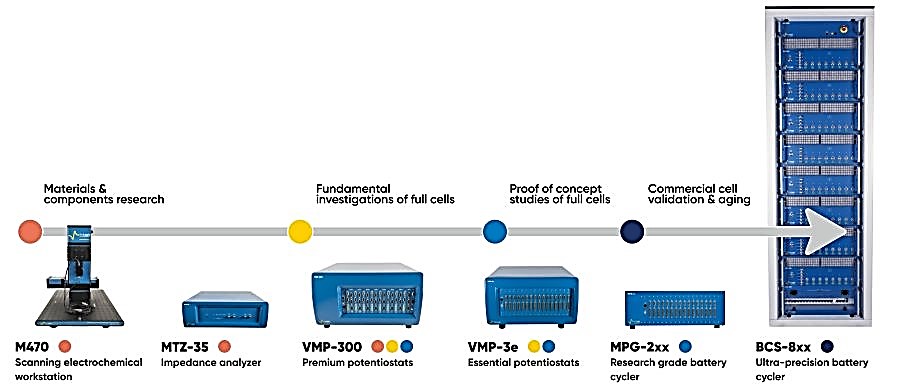
Developing and testing ASSB technology
Potentiostats, impedance analysers and battery cyclers support investigations from individual materials through complete cells. Complementary techniques answer different questions:
- X-ray diffraction: crystal structure and its changes during cycling.
- Scanning electron microscopy: microstructure, defects and contact morphology.
- Scanning electrochemical microscopy: local electrochemical behaviour in a suitable experimental configuration; local measurements require their own interpretation.
- Thermal analysis: thermal behaviour and stability of battery materials.
Controlled electrochemical experiments and structural or thermal characterisation together help assess components under relevant conditions.
Conclusions and retained references
ASSBs offer potential improvements in energy storage, but materials, manufacture and performance remain interconnected challenges. Benefits must be demonstrated for an actual cell rather than inferred solely from its solid electrolyte.
The original article cites:
- Lim, H.-D. et al. A review of challenges and issues concerning interfaces for all-solid-state batteries. Energy Storage Materials 25, 224–250 (2020).
- Kasemchainan, J. and Bruce, P. G. All-solid-state batteries and their remaining challenges. Johnson Matthey Technology Review 62, 177–180 (2018).
- Lou, S. et al. Interface Issues and Challenges in All-Solid-State Batteries: Lithium, Sodium, and Beyond. Advanced Materials 33 (2021), DOI.
Further reading: BioLogic on solid-electrolyte conductivity, DCA and cycling curves.
Original Arrhenius example
Assume Eₐ = 0.30 eV and an unchanged σ₀. Then σ(323 K)/σ(298 K) = exp[(0.30/kᵦ) × (1/298 − 1/323)] ≈ 2.47. This idealised ratio is not a measured material property. Absolute conductivity also requires σ₀ or a known reference value.
Record sample thickness, electrode area, temperature, contact arrangement and applied pressure. Support separation of bulk, grain-boundary and electrode-interface responses with the model and measured frequency range. Our EIS guide provides the measurement context.