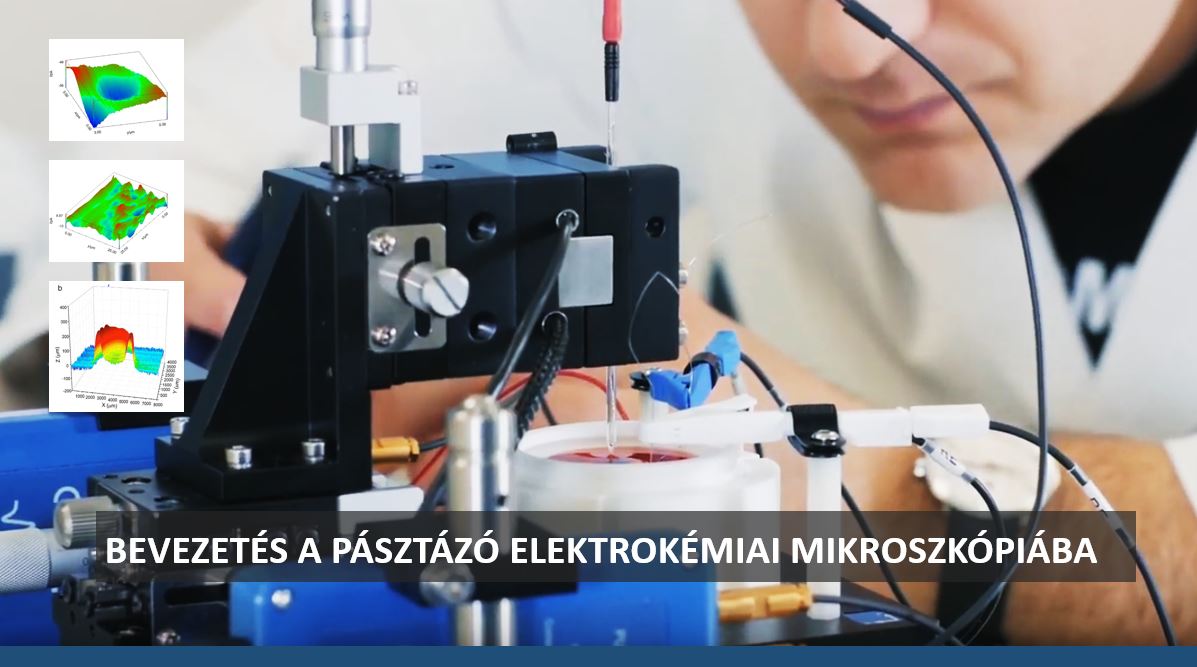
Introduction
Scanning electrochemical microscopy, SECM, is used to investigate local electrochemical properties in areas such as:
- Heterogeneity of battery electrodes.
- Electrochemical behaviour of graphene, nanotubes, MoS₂ and other two-dimensional materials.
- Effects of alloy composition and crystal orientation on corrosion.
- Local activity of electrocatalysts.
- Photosynthetic processes near plant leaves.
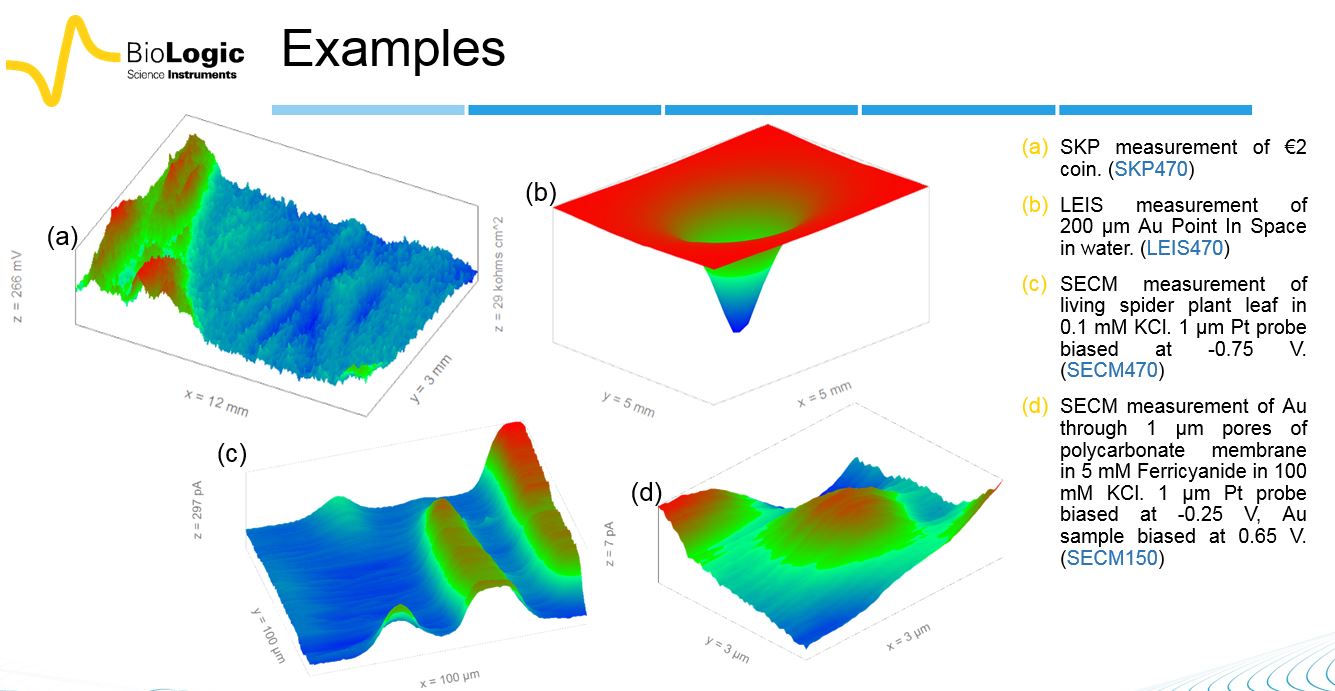
Measurements usually take place in electrolyte, permitting in situ investigation when sample and cell are compatible. Preparation may still be necessary, and electrolyte or mediator can itself alter the sample.
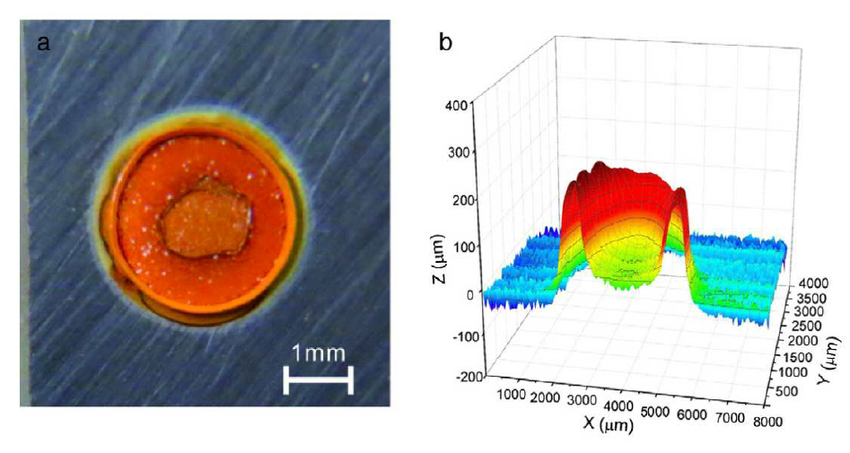
The archived example compares optical morphology and an electrochemical/topographic view of corroding X65 steel beneath a water droplet, citing R.J. Jiang and Y.F. Cheng, Electrochemistry Communications 35 (2013), 8. In that example, anodic and cathodic regions were described as spatially separated: iron dissolution predominantly near the centre, oxygen-reduction-related hydroxide production toward the edge, and corrosion products in an intermediate ring. This illustrates a particular droplet environment, not a universal distribution or a direct map of separate metal potentials.
Spatial resolution depends jointly on probe size, distance, diffusion, sampling and noise. Small positioning increments are not identical to image resolution; submicrometre resolution requires an appropriate specialised configuration.
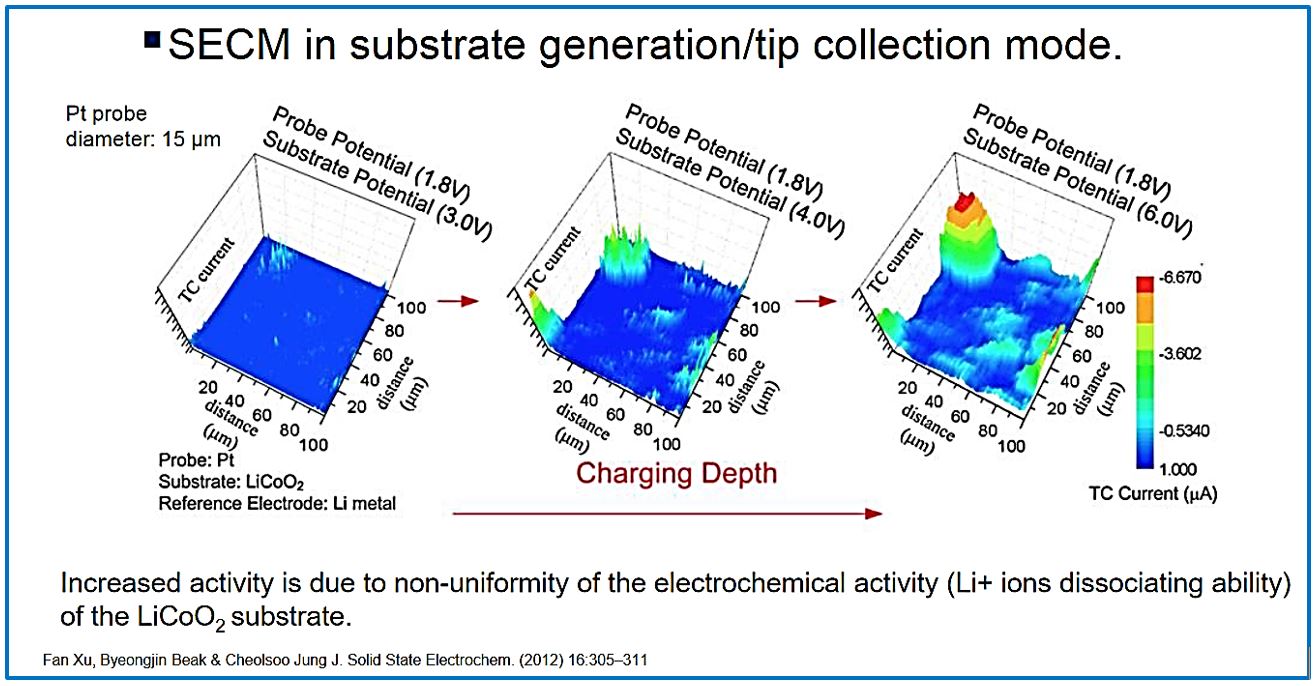
The battery illustration highlights heterogeneous behaviour. Depending on configuration, ex situ, in situ or operando experiments can probe different processes. Conventional whole-electrode measurements integrate contributions across the exposed surface; they generally do not localise which region produced a feature. Mapping can complement them by resolving local contrasts.
SECM also supports suitable biological investigations. The retained leaf example relates to electrochemical imaging of photosynthesis:
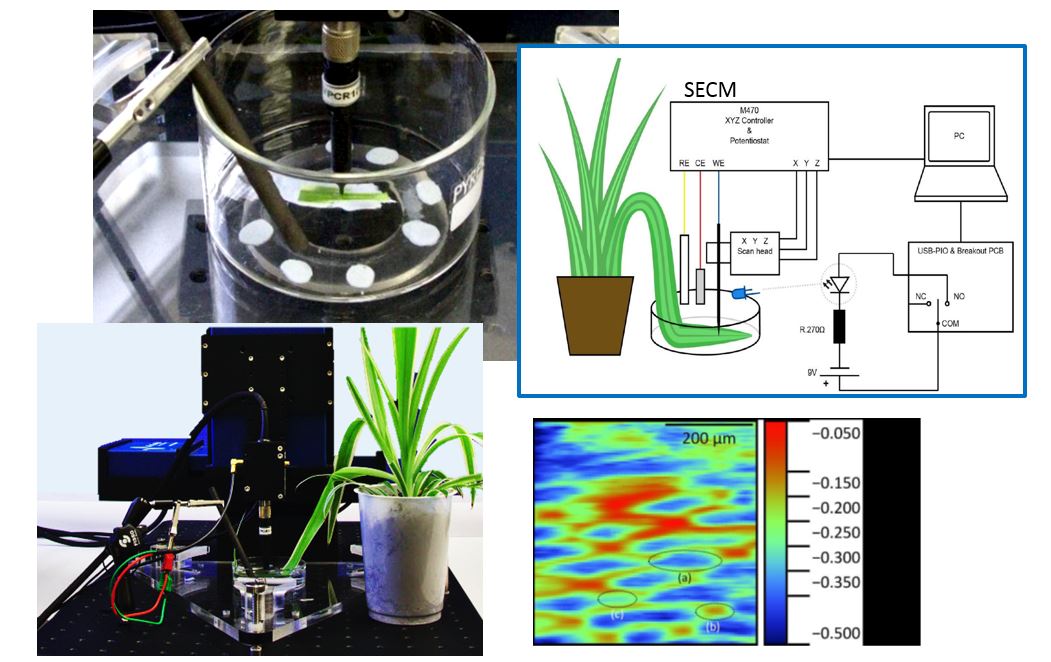
The original article drew on BioLogic’s learning materials, particularly its SECM introduction. The following explanation retains that local archived structure with targeted clarifications.
What is SECM?
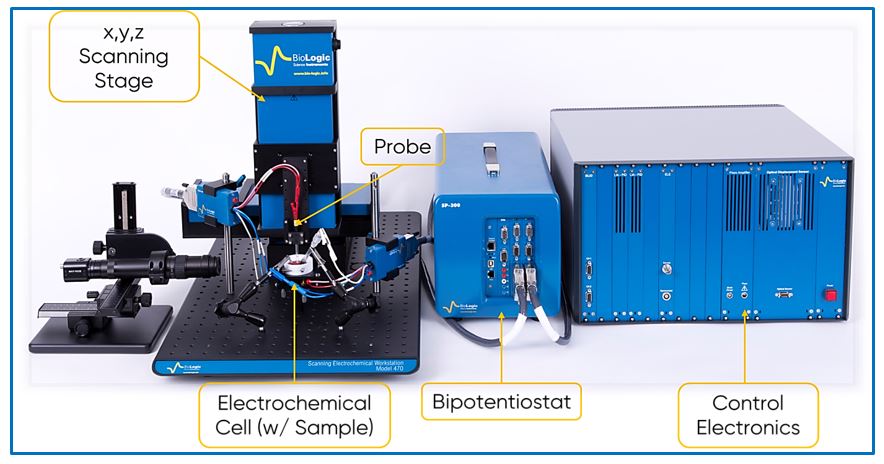
SECM is a scanning-probe method for measuring local electrochemical responses in solution. A positioning stage moves the probe in x, y and z:
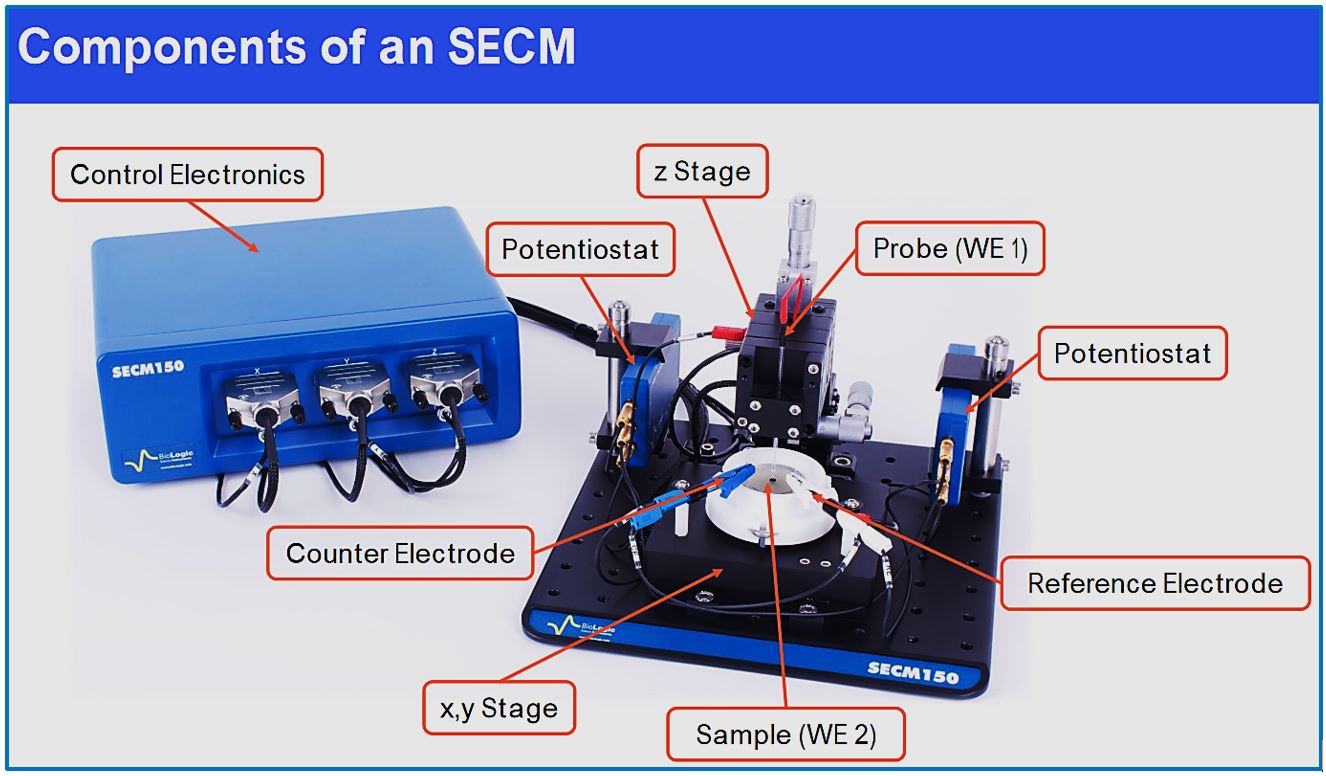
A potentiostat controls the probe. If the sample must also be independently polarised, use an appropriate two-working-electrode/bipotentiostat configuration. Software associates the measured signal with position to form a map.
In feedback mode, the probe reacts with a redox mediator. The nearby sample modifies mediator transport or regeneration, providing chemical sensitivity. Bard and co-workers’ 1989 work [1] built on earlier microelectrode studies near polarised macroelectrodes [2]. Importantly, nearby insulating surfaces also affect the signal, and the response depends on probe–sample distance even when the sample is not separately polarised.
Alongside DC-SECM, AC and constant-distance modes are available. This article mainly addresses feedback mode; the manufacturer comparison describes other modes.
How feedback works
A biased ultramicroelectrode, UME, oxidises or reduces an electroactive species. The measured Faradaic current depends on the reaction and transport near the probe. In a common feedback arrangement, the sample remains at open-circuit potential.
For an ideal disk UME embedded in a plane, far from the sample, under steady diffusion-limited conditions:
iss = 4nFDCr.
Here n is electron number, F the Faraday constant in C/mol, D diffusion coefficient in cm²/s, C bulk concentration in mol/cm³ and r disk radius in cm. The current is proportional to concentration under these assumptions. It is not the general expression for current at any distance above a reactive sample.

The sketch shows radial transport toward a small disk electrode.
An insulating surface can impede mediator supply, decreasing current magnitude: negative feedback. A sample that regenerates mediator sufficiently rapidly can increase current: positive feedback. Conductivity alone does not determine the outcome; potential, reaction kinetics and geometry also matter. An unbiased conductor may regenerate mediator when its charge balance permits it.
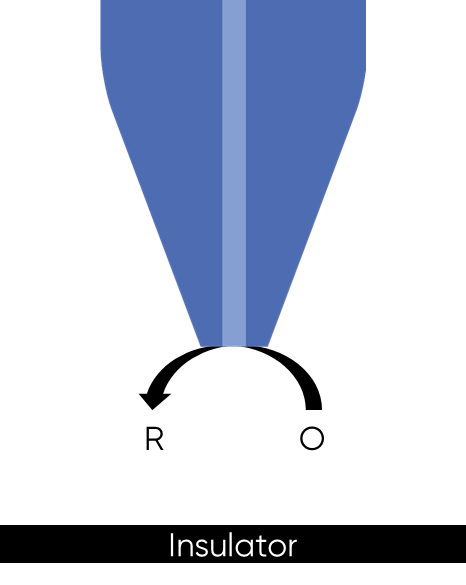
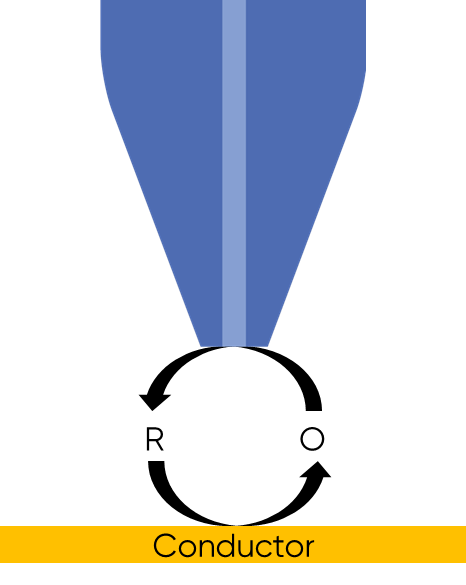
Decreasing the gap strengthens negative feedback over an ideal insulator, or positive feedback over a sufficiently reactive surface:
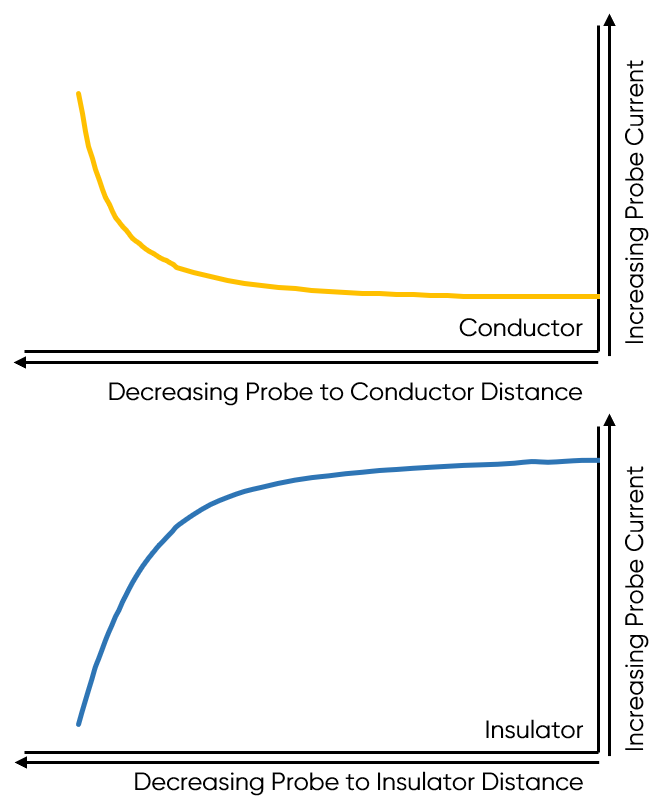
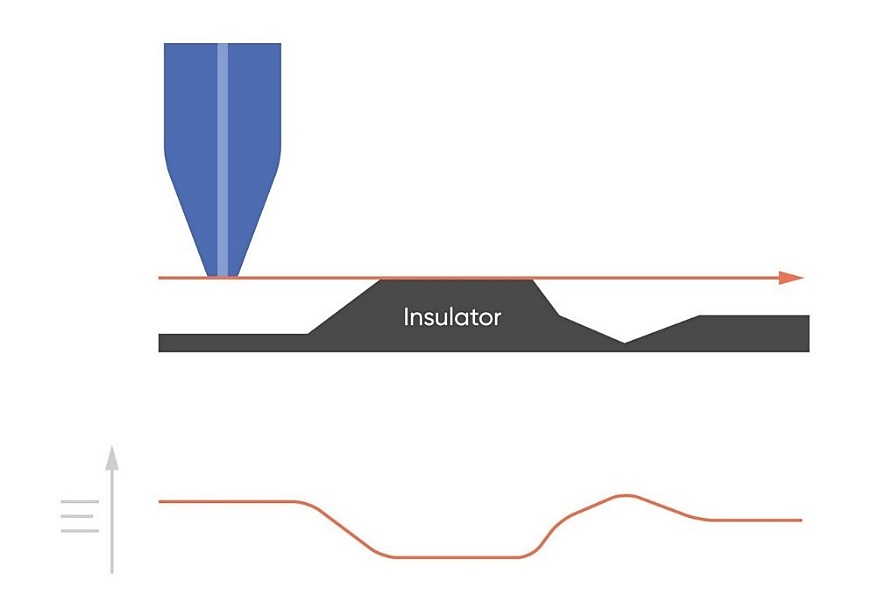
Two influences must therefore be distinguished: activity and topography.
At a constant probe height above a uniformly insulating rough sample, peaks reduce the gap and usually lower current magnitude; valleys increase the gap and weaken negative feedback.
A flat but electrochemically heterogeneous sample can also produce current variations, now at constant distance, because regeneration differs across regions.
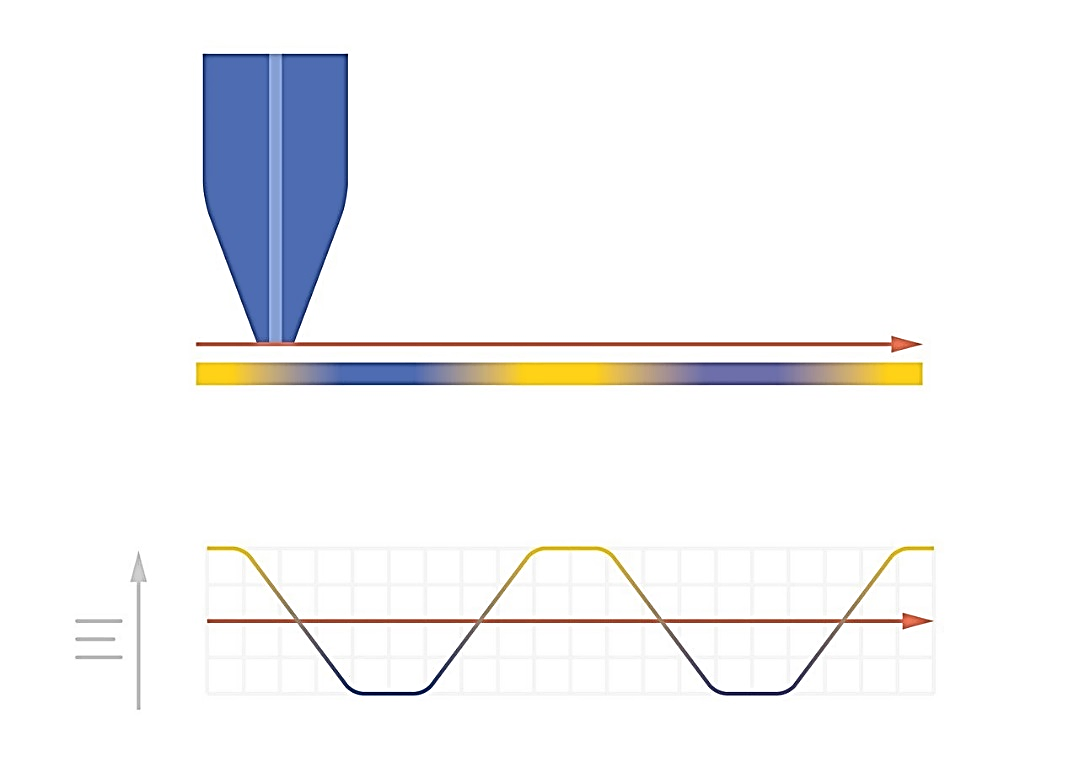
Distance control or independent topography can help interpret mixed contrast. The duplicated paragraph in the original article has been consolidated.
Approach curves, line scans and maps
An approach curve records response against z position or gap. It is commonly used to position the probe before scanning, and can itself probe distance-dependent kinetics or changes such as sample swelling [3,4]. Applications include interfaces that are difficult to examine with whole-electrode methods, including cells and two-dimensional materials.
A line scan moves the probe laterally in x or y. Repeated lines at successive positions form an area map. Repeating maps can reveal changes with time, provided scan duration and drift are considered.
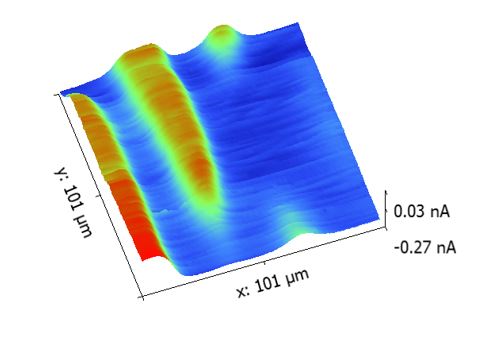
Archived spider-plant leaf map using a platinum probe to detect oxygen. The original caption incompletely specified the electrolyte and reference for its stated potential; it is retained as an illustration rather than a reproducible measurement recipe.
A probe can also remain stationary near a surface to investigate species released, adsorbed, desorbed or dissolved. Such experiments depend on transport between the sample and probe and need not produce an image.
Components and probe selection
A SECM system includes x–y–z motion, a stable cell/sample support, a UME and suitable potentiostat electronics. Tilt and vibration affect distance control. Feedback may require only one controlled working electrode, whereas independently polarised probe and sample need compatible channels.
A typical UME contains an active material within an insulating sheath, polished to expose a disk. The active diameter affects signal and resolution, together with gap, transport and mode. Probe dimensions should be chosen for the feature and required sensitivity. A feature smaller than the diameter can sometimes be detected without being fully spatially resolved.
The original practical guidance places the probe within roughly one or two active diameters for useful contrast, but this is not a universal optimum. Smaller probes generally require smaller gaps and more demanding positioning.
Sheath geometry is described by RG = R/r, where R is the outer insulating radius and r the active radius. It affects transport blocking and approach curves. A large sheath can block diffusion at greater distances; very small RG can weaken insulating-surface contrast. RG near 10 is a common example rather than a requirement, and small probes may use larger sheaths for robustness.
Active material determines the accessible reactions and potential window. Platinum is common in the literature [5], but it is not appropriate for every chemistry.
Advantages and limits
SECM can localise activity that is averaged in a whole-electrode response, such as differences between grains and grain boundaries. Suitable non-contact operation can reduce mechanical disturbance of delicate samples, including battery interfaces and two-dimensional flakes. This does not guarantee absence of chemical or electrochemical perturbation.
Conducting and insulating samples can both be examined with compatible modes, electrolytes, mediators and surfaces. Examples include liquid–liquid interfaces, biological specimens, two-dimensional materials, arrays, catalysts and battery electrodes. This does not imply every sample can be measured without preparation or in an arbitrary chemical environment.
Reaction selectivity comes from electrode material, potential and chemistry. It can support studies of catalysts, sensor interactions, metabolite release and ion insertion/extraction, but a current map is not automatically a selective concentration map for any chosen species.
Application areas
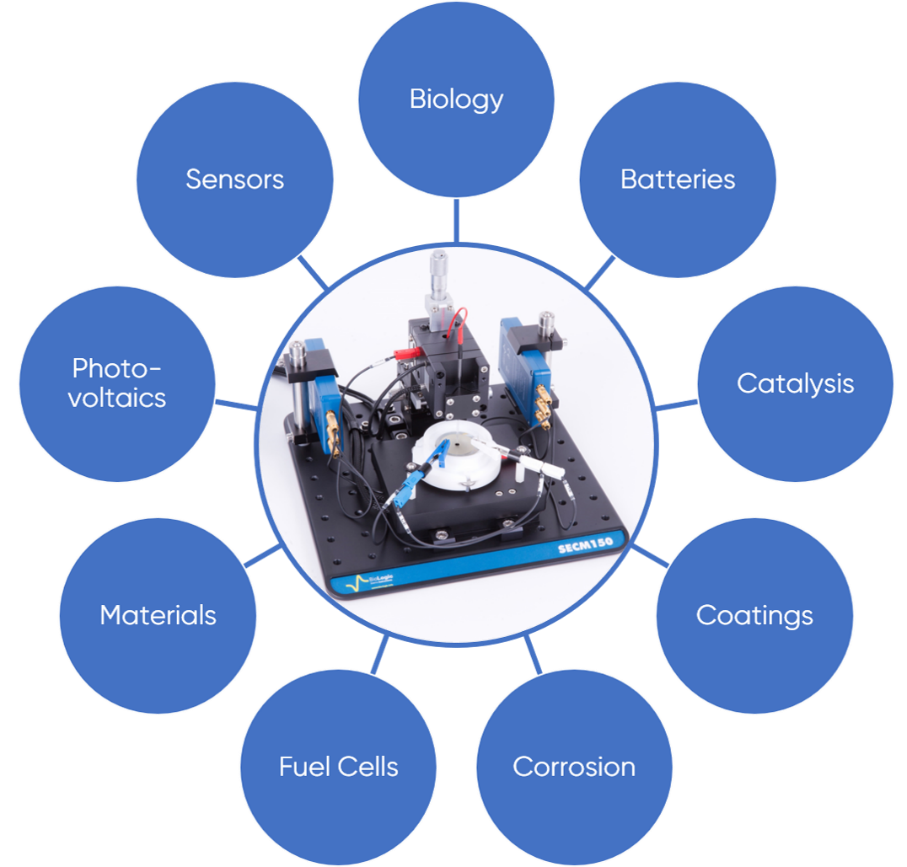
The archived references illustrate:
- Corrosion processes [6].
- Coating degradation [7].
- Solid-electrolyte-interphase development on battery electrodes [8].
- Fuel-cell catalyst screening [9].
- Living-cell morphology [10].
- Ion transport across membranes [11].
- Electronic/electrochemical properties of two-dimensional materials [12].
Further discussion is available in the local application examples, BioLogic fuel-cell scanning-probe overview and SECM imaging tutorials.
Glossary
- Faradaic current: current associated with oxidation or reduction.
- Feedback mode: probe response to mediator transport and regeneration modified by a nearby sample; the sample may remain unbiased.
- Positive feedback: enhanced probe current magnitude associated with mediator regeneration under suitable conditions.
- Negative feedback: reduced probe current magnitude associated with impeded mediator supply.
- Redox mediator: an electroactive species participating in the probe/sample reaction cycle.
- RG: outer sheath radius divided by active probe radius.
- Scanning-probe electrochemistry: a broader family including SECM, SKP, LEIS, SDC and SVET; these measure different physical quantities.
Editorial measurement checklist
Record probe diameter and RG, potential/reference, mediator, gap, scan speed and timestamps. A map consists of sequential measurements, not necessarily an instantaneous snapshot. The far-field iss expression cannot be used to interpret every near-surface current change as concentration alone. Separate activity, geometry and temporal effects before drawing mechanistic conclusions.
References retained from the original article
- J. Bard, F. R. F. Fan, J. Kwak, O. Lev, Anal. Chem. 61 (1989) 132-138
- C. Engstrom, M. Weber, D. J. Wunder, R. Burgess, S. Winquist, Anal. Chem. 58 (1986) 844-848
- Elkebir, S. Mallarino, D. Trinh, S. Touzain, Electrochim. Acta 337 (2020) 135766
- Fic, A. Płatek, J. Piwek, J. Menzel, A. Ślesiński, P. Bujewska, P. Galek, E. Frąckowiak, Energy Storage Mater. 22 (2019) 1-14
- Polcari, P. Dauphin-Ducharme, J. Mauzeroll, Chem. Rev. 116 (2016) 13234−13278
- Kong, C. Dong, Z. Zheng, F. Mao, A. Xu, X. Ni, C. Man, J. Yao, K. Xiao, X. Li, Appl. Surf. Sci. 440 (2018) 245–257
- Morimoto, A. Fujimoto, H. Katoh, H. Kumazawa. AIAA Scitech 2019 Forum, 7-11 January 2019, San Diego, California
- Liu, Q. Yu, S. Liu, K. Qian, S. Wang, W. Sun, X.-Q. Yang, F. Kang, B. Li, J. Phys. Chem. C 123 (2019) 12797-12806
- Black, J. Cooper, P. McGinn, Meas. Sci. Technol. 16 (2005) 174
- Razzaghi, J. Seguin, A. Amar, S. Griveau, F. Bedioui, Electrochim. Acta 157 (2015) 95–100
- J. Jackson, J. M. Sanderson, R. Kataky, Sens. Actuators B Chem. 130 (2008) 630–637
- Henrotte, T. Bottein, H. Casademont, K. Jaouen, T. Bourgeteau, S. Campidelli, V. Derycke, B. Jousselme, R. Cornut, ChemPhysChem 18 (2017) 2777 – 2781