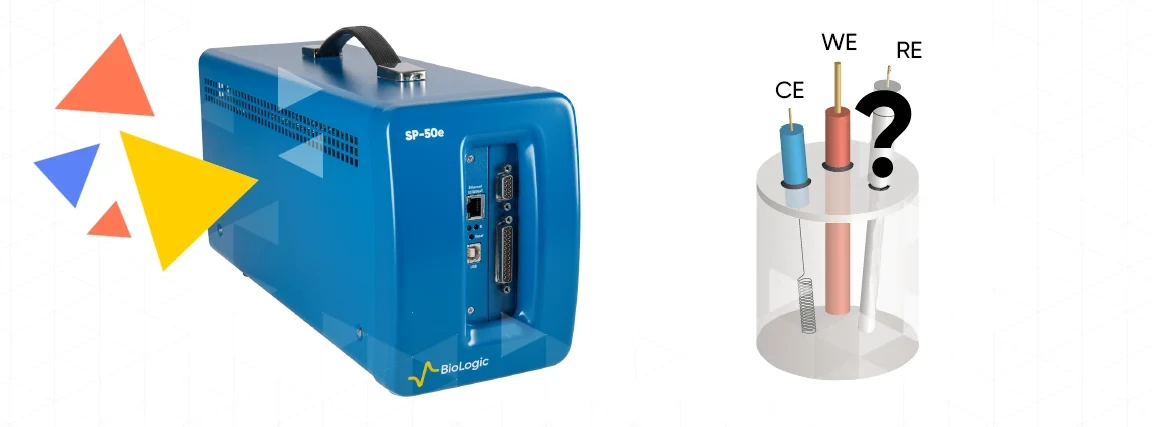

An EC Labor measurement guide with manufacturer references and our own calculated example.
The reference is part of the measurement
A reference electrode provides a stable, known potential. If that potential changes, interpretation of phenomena at the working electrode can become uncertain.
Start with the electrolyte
Aqueous or non-aqueous medium, pH, temperature and chemical compatibility all influence the choice. It is also important to consider whether substances leaving the reference electrode could alter the system being studied.
For EIS, consider the electrode impedance, particularly at high frequencies. The BioLogic guide includes practical checks of connections, internal solution and porous junction condition. Always select the specific electrode for the experimental conditions.
BioLogic: selecting a reference electrode.
What does a 15 mV reference shift mean?
In our arithmetic example, the working electrode is at +0.450 V on a common scale. Reference A is at +0.200 V on that scale, giving E(WE−A) = 0.450 − 0.200 = +0.250 V. These are invented values, not tabulated potentials for a commercial electrode.
If the reference changes to +0.215 V while the working electrode remains unchanged, the displayed difference becomes +0.235 V. The apparent −15 mV shift comes entirely from the reference in this example. Conversely, if the potentiostat maintains a +0.250 V difference, the working electrode moves to +0.465 V on the common scale.
Scroll the table horizontally on narrow screens.
| Situation | Reference | Working electrode | WE − reference |
|---|---|---|---|
| Initial | +0.200 V | +0.450 V | +0.250 V |
| Only reference changes | +0.215 V | +0.450 V | +0.235 V |
| Controlled difference maintained | +0.215 V | +0.465 V | +0.250 V |
This is ideal subtraction, excluding other measurement errors. It cannot retrospectively correct unknown drift; 15 mV is not an acceptance limit. The final two rows describe separate experimental situations, not successive stages of one measurement.
How can its condition be checked?
BioLogic recommends tracking stability through an open-circuit comparison against a reference reserved for verification. Checking impedance is a separate task. BioLogic: checking reference electrodes.
Our proposed record includes electrode identifiers, solution, temperature, connection polarity, waiting time and the complete potential–time trace. One voltage reading does not establish whether the signal had stabilised. Different reference types need not have a zero expected difference.
Comparing the initial and later states of A against an unchanged B in our example would increase A−B by 15 mV. In real verification, B must not simply be assumed constant: its history and comparison conditions form part of the evidence.
Position is a measurement parameter
A Luggin capillary opening defines where the reference senses solution potential. It can bring that sensing point closer to the working electrode, while its electrolyte path adds impedance to the reference branch. Manufacturer background: Gamry reference-electrode guide.
We would document the arrangement with a photograph or dimensioned sketch showing electrode area, capillary tip, distance and immersion depth. Restore the same geometry between runs. There is no universal “correct distance” to enter without considering the cell and current distribution.
Stable potential does not exclude EIS artifacts
Reference impedance combined with instrument stray capacitance can distort the high-frequency response. AN44 also demonstrates how a measurement artifact can yield a misleadingly good fit. BioLogic AN44.
Our practical conclusion: passing an OCV check does not automatically validate the entire frequency range. When comparing a replacement reference, preserve cell state, geometry and settings wherever possible. Discuss AC bypass arrangements for the actual instrument and electrode; a capacitor alone cannot repair a chemically unstable reference.
A decision record for the next experiment
Our suggested worksheet makes the selection traceable:
- Medium: solvent, composition, pH, temperature and acceptable contaminants.
- Electrode: exact model, filling solution, manufacturer use and storage instructions, latest verification.
- Symptom: offset, drift, noise or a deviation confined to certain frequencies.
- Intervention: one documented change at a time, followed by a comparable repeat.
- Reporting: reference type, filling solution and temperature alongside potential; conversion equation and its conditions when changing scales.
Read how a potentiostat works and our EIS data-quality guide for the measurement context. Contact the local representative to discuss the cell and reference arrangement.