MOS-500 spectropolarimeter
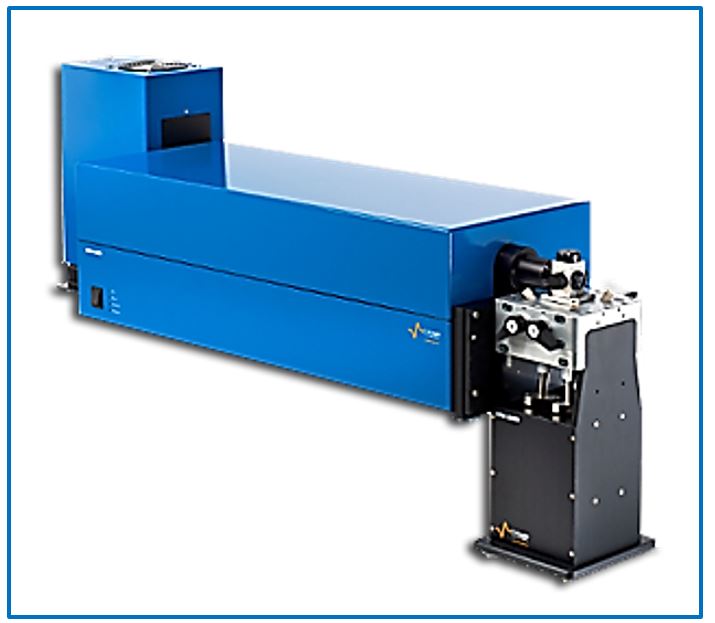
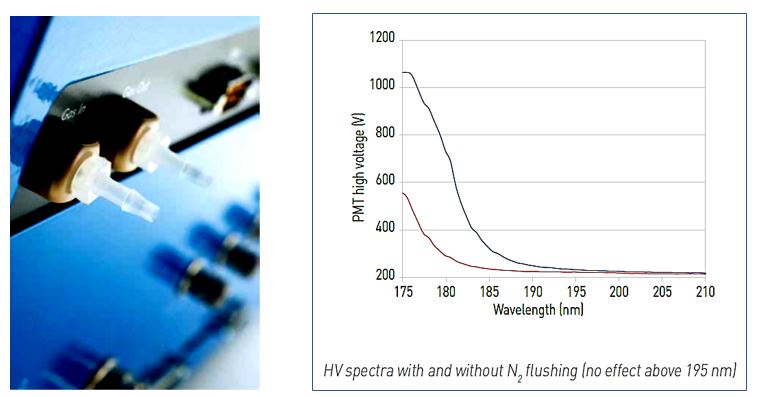
The MOS-500 uses a patented three-stage wavelength-selection system. Its design supports a wide wavelength span and multiple optical measurement modes; usable sensitivity also depends on the sample and settings. The manufacturer specifies optical nitrogen purging for work below 195 nm. Set gas supply according to the manual for the actual instrument.
A dual lamp housing and optional tungsten source support different spectral regions. The modular instrument extends beyond circular dichroism, with detection modes and accessories including stopped-flow and optical rotatory dispersion.
Specifications and their context
- Standard wavelength range: 163–950 nm. The current product page describes an optional extension to 1250 nm. “0 nm” denotes a white-light setting, not light with zero wavelength.
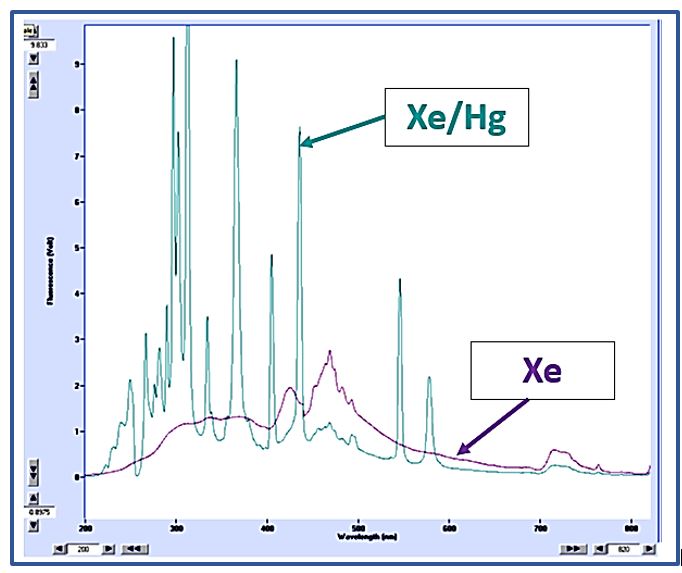
- The historical description specifies air-cooled 150 W Xe and Xe/Hg sources, with tungsten optional.
- Patented chromatic illumination combined with a double-grating monochromator.
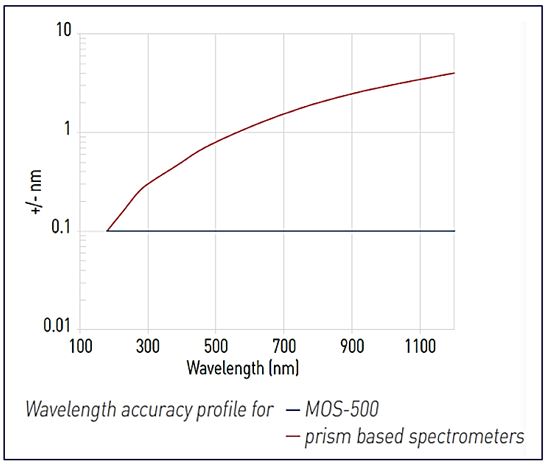
- Manufacturer wavelength accuracy: ±0.1 nm across the specified range.
- Nitrogen purging follows the requirements for wavelength and configuration.
- Optional Peltier control with separate holder and sample sensing; confirm accuracy in the accessory datasheet.
- Check baseline stability at the actual wavelength and measurement duration.
- CD resolution is not the same as noise or the smallest detectable signal; use specifications with their measurement conditions.
- The earlier description lists CD linearity to 3 absorbance units and a CD range of ±7500 mdeg, or ±8000 mdeg for a modified version; confirm the supplied configuration.
- Its photometric range is described as 0–3 absorbance units, extending to 5 with reduced accuracy; the quoted photometric accuracy is ±0.001 absorbance units under the applicable specification conditions.
- Listed modes include CD, absorbance, detector high voltage, fluorescence, FD-CD, fluorescence anisotropy/polarisation, linear dichroism and HPLC-CD. Optional modes/accessories include NIR-CD, ORD, DR-CD, stopped-flow, titration and emission fluorescence. Availability requires confirmation for the selected optics and accessories.
- Biokine handles control, acquisition and processing. Historical dimensions are 139 × 32 × 39 cm, with a mass of 35 kg; check the footprint of accessories separately.
Baseline stability and wavelength selection
Long measurements and titrations require stable baselines. Compare noise and drift for your method rather than relying on the original article’s general competitor ranking.
Chromatic illumination and the grating design support a broad wavelength range. Prism dispersion changes with wavelength; the retained manufacturer illustration presents the claimed wavelength-accuracy comparison, not an independent contemporary benchmark.
Optical signal and detector selection
The optical path and photomultiplier choice aim to obtain useful signals from far-UV to NIR. For fluorescence, specify excitation and emission wavelengths, filters and detector sensitivity separately. The need for a specialist PMT and its compatibility depend on the actual configuration.
Dual light source
The original description favours xenon for UV–visible measurements and Xe/Hg for selected wavelengths.
Nitrogen purging
Oxygen absorption and optical protection can require purging in the far-UV. It is not valid to generalise that purging above 195 nm is useless for other instruments: optical design and the manufacturer’s procedure govern operation.
Sample temperature control
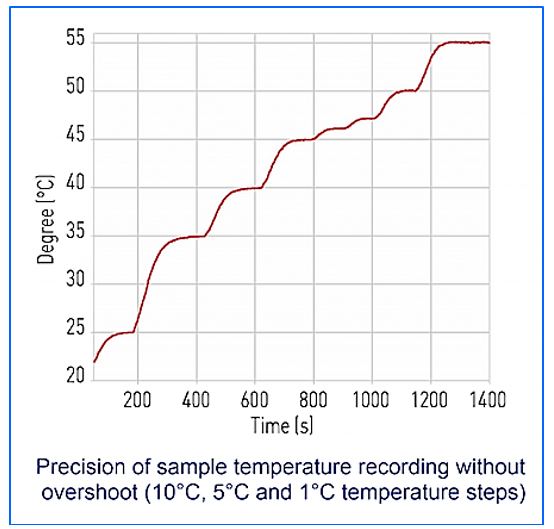
The illustrated BioLogic Peltier accessory uses separate sensors for the holder and sample in the cuvette. Direct sample sensing helps interpret a thermal program, but does not guarantee instantaneous settling or absence of overshoot for every sample. Cycles and steps can be programmed in Biokine.
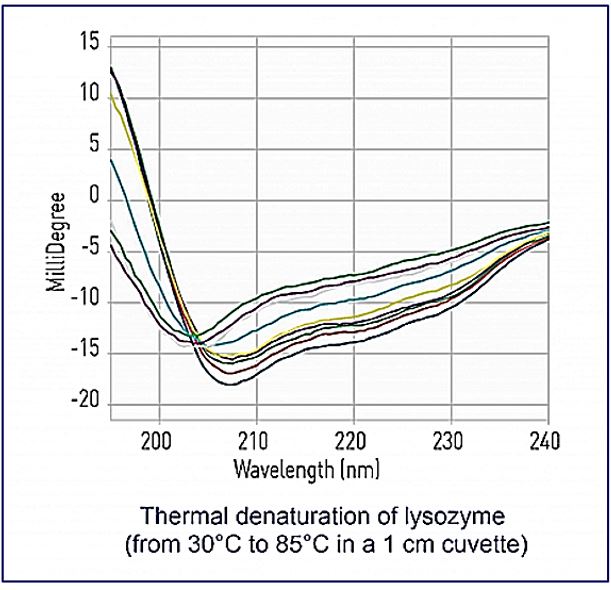
Record a CD spectrum at each temperature step or follow the signal at one wavelength. A transition may provide an estimate of Tm; extracting ΔCp and ΔS requires a suitable thermodynamic model, sufficient data and checks of its assumptions. The retained example shows lysozyme thermal-denaturation spectra.
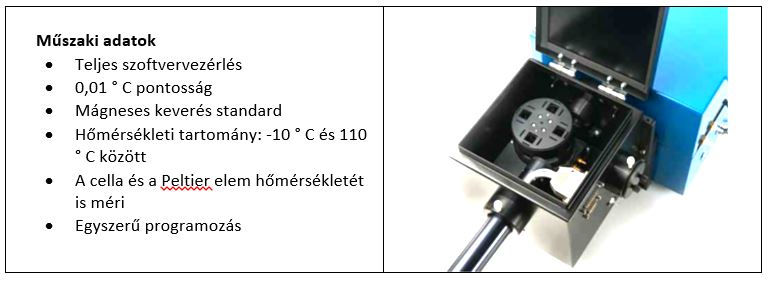
The illustrated four-cell holder supports programmed temperature control and automated measurement of several samples, with magnetic stirring for each cell. Moving samples into the beam is not equivalent to four simultaneous optical channels. The old text and figure gave different temperature ranges; use the combined specification of the actual holder, cuvettes and circulating unit. Biokine controls position changes and the thermal program.
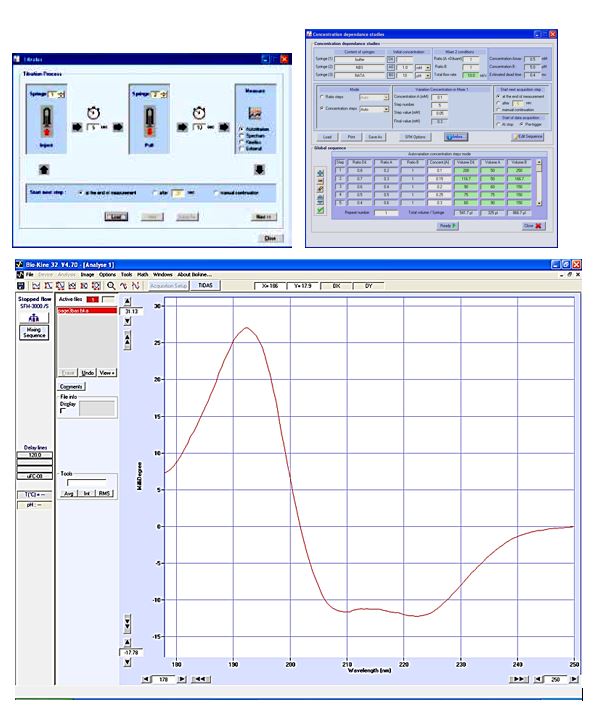
The MOS-500 and supported accessories are controlled through Biokine. Acquisition parameters can be selected from a configuration window; files can be saved for internal analysis or exported for subsequent work such as secondary-structure analysis. The screenshots below show an earlier interface.