Even scientists who have encountered a potentiostat during their studies may regard it as a specialised instrument needed only by a small community. This original article introduces its development and applications in nanotechnology, batteries, fuel cells, photovoltaics, membranes, biophysics and corrosion.
The article was prepared for MŰSZEROLDAL and published in 2016. It is retained as the original author’s overview. Product figures and illustrations are historical examples. For present-day experimental planning, see the separate practical potentiostat guide.
What is a potentiostat and how does it work?
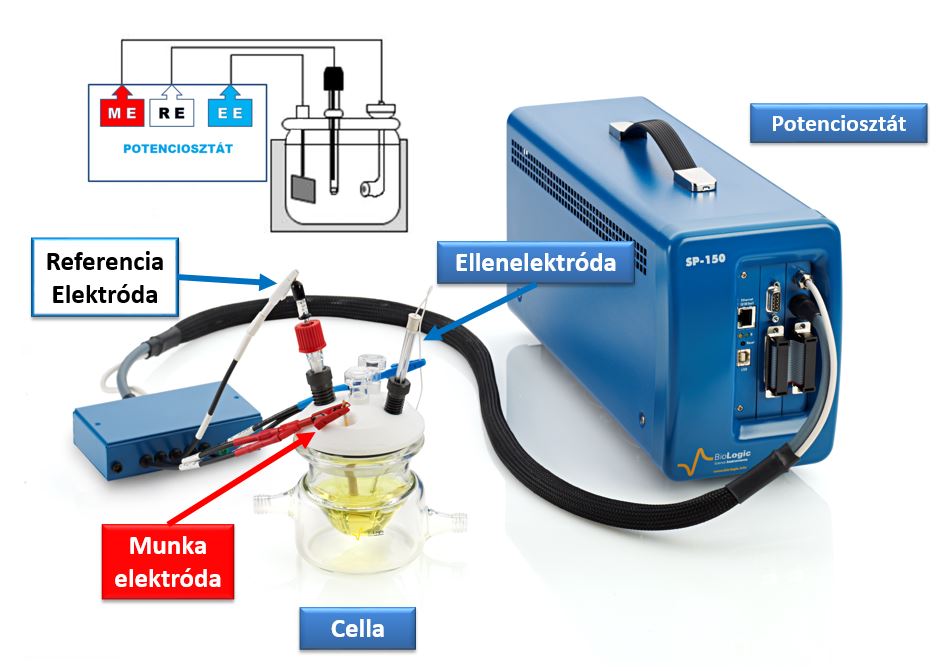
A potentiostat is a fundamental electrochemical instrument. In a three-electrode cell it adjusts current so that the working-electrode potential against a reference follows the programmed value, while recording the response.
It holds the working/reference potential constant or changes it according to a defined program, recording the current between working and counter electrodes against time, potential or scan conditions.
The earlier drawing below shows a BioLogic SP-150 connected to a three-electrode cell, with colour-coded leads. It is not a universal connection guide for every BioLogic instrument.
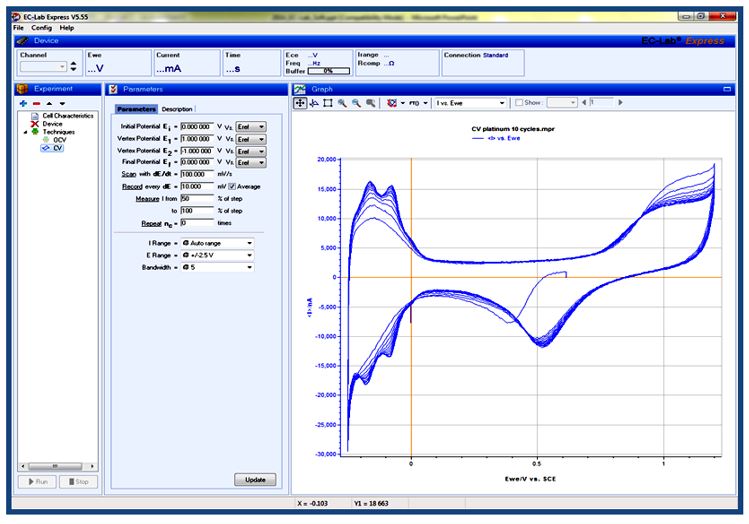
Potentiostats also support corrosion measurements, including estimation of corrosion rate under defined conditions and evaluation of protective coatings. Wider applications encouraged multichannel systems, additional connection modes and combinations with other instruments.
Historical instrument example: SP-150
The article’s instrument example is the SP-150. The following specifications were reported in 2016; they are not current SP-150e specifications or a standalone purchasing datasheet.
The modular SP-150 could be expanded with separate options. The original list included:
- Current ranges described as 10 µA–800 mA; this does not define the smallest measurable current.
- Resolution of 760 pA, or 76 fA with the stated low-current option.
- A voltage range quoted as ±10 V.
- Potential resolution of 5 µV and optional EIS from 10 µHz to 1 MHz.
- Acquisition time of 20 µs using EC-Lab Express.
- Sine-wave amplitude from 1 mV to 1 V.
Historical options included EIS, low-current work and external high-current boosters. The old 1 nA range and 2–100 A booster list do not imply freely interchangeable options for every instrument. For an existing instrument, identify the precise model, generation and compatible accessory documentation.
Control software
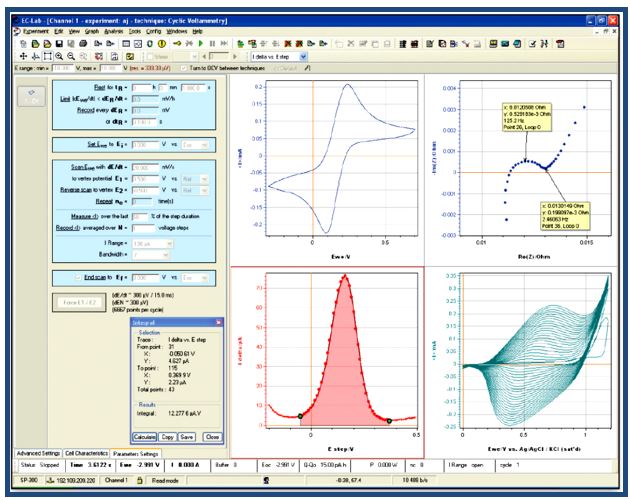
The earlier SP-150 account described EC-Lab and EC-Lab Express, more than seventy techniques, approximately 150 EIS circuit templates and two minimisation algorithms. Those numbers refer to the releases discussed at the time. Fitting tools help analysis, but the physical validity of a model still needs checking.
Supported rotating-disc electrodes and accessories, such as quartz-crystal microbalance analysers, can be incorporated into an experiment. The original author highlighted the logical interface and graphical presentation as useful features.
In supported configurations, multiple users can work with channels and their own datasets. The quotation determines the supplied package and licence terms; updates follow manufacturer registration and compatibility requirements. The following image illustrates an earlier interface and its acquisition and analysis windows.
Small electrodes and sensors create demanding low-current measurements. Resolution or sensitivity stated in fA is not equivalent to accuracy obtainable on an arbitrary sample. Noise, wiring, insulation and current range jointly determine whether a micro- or nanoelectrode response is usable. EIS can also be performed with a suitable low-current configuration.
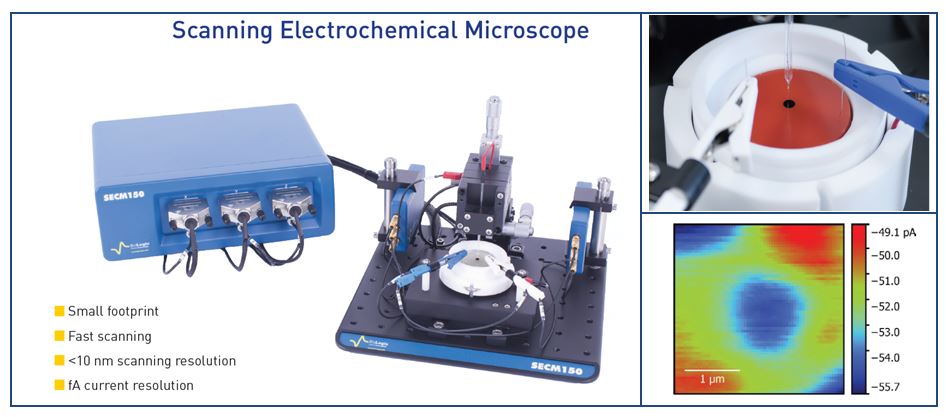
A scanning electrochemical microscope (SECM) measures local electrochemical response while moving a probe. The original abbreviation “SEM” was incorrect: an electron microscope is a different technique. The following example illustrates a surface measurement in solution.
Demand from electric vehicles, stationary energy storage and portable devices has driven battery development. Potentiostats support investigation of electrodes, electrolytes and separators, optimisation of cell construction and tests during development. Parallel experiments can reduce the time needed to examine multiple samples.
Multichannel systems enabled parallel work and sequences combining potentiostatic and galvanostatic steps. The earlier claim of a “first instrument in 1993” is not used here as a purchasing argument.
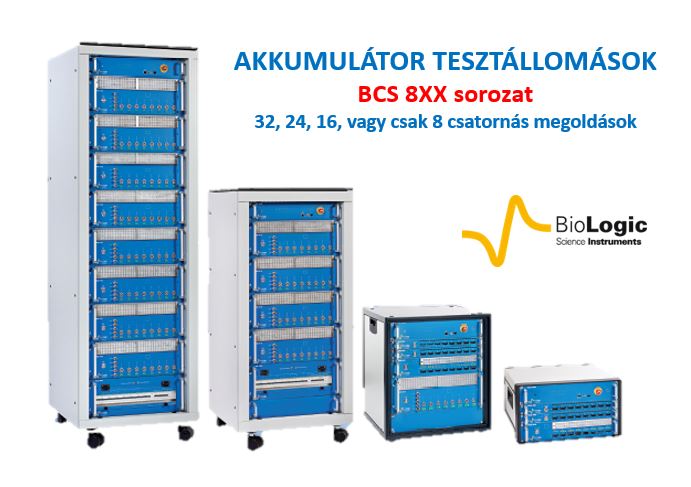
A suitable chassis may contain multiple channels, including up to sixteen. Parallel high-current operation of channels or boosters is possible only in supported configurations: independent channel count and combined current are different requirements. EIS requires the appropriate option.
EIS complements cycling with frequency-dependent information. Measurement duration depends on frequency and settings and can be long at low frequencies. A complete-cell spectrum does not uniquely identify a fault in the cathode, anode, separator or electrolyte. Estimating state or lifetime requires a validated model and further data.
The historical battery-test-station example is the BCS-800 family, including BCS-815; “BTS-815” in the earlier text was a typographical error. The image shows the product range of that period.
Potentiostats contribute to fuel-cell and electrocatalyst research. The 2016 article mentioned renewable-energy work at Hungary’s Research Centre for Natural Sciences and publications of the Hungarian Hydrogen and Fuel Cell Association. These are historical references, not an updated project directory.
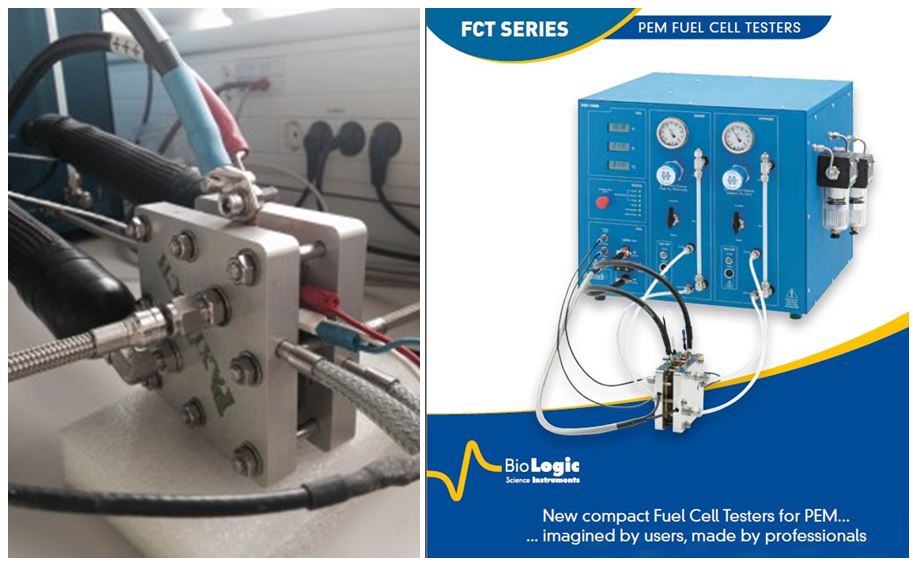
Complete test stations can combine electrical measurement with gas delivery and computer-controlled acquisition. The retained FCT illustration shows such a system and a connected cell.
Further applications described in the original article
- Photovoltaic development and testing.
- Materials research involving ceramics, sensors, nanoscale materials, polymers, epoxies, adhesives, liquid crystals, biological cells, ferroelectrics and polar liquids, using appropriate electrochemical or impedance methods.
- Spectroelectrochemistry and reaction kinetics, including redox processes, structural changes, peptide interactions and enzymatic or catalytic reactions in biophysics, biochemistry and photosynthesis research.
- Classical electrochemical and corrosion measurements.
Combining electrochemical control with other measurement tools has produced scanning electrochemical workstations, battery and fuel-cell test systems, materials-impedance systems and spectroelectrochemical or spectrokinetic arrangements. Their relevance depends on the actual method and configuration, rather than a single instrument covering all tasks without modification.
Original author: István Kovács, Candidate of Chemical Sciences, managing director of Labornite Kft. Contact: info@labornite.hu; Labornite.